Photo by Giorgio Trovato
7 Self-Help Books to Meet You Where Life Hurts
By Bob Kerr
Real talk: Life hurts. Although the stigma surrounding mental health prevails, more and more people are opening up about their struggles on social media. Not only that, store shelves are teeming with self-help books for facing life’s challenges, healing trauma and feeling less alone. Suffice to say, we are spoiled for choice.
And that can be a problem.
I mean, which of the hundreds of books on ADHD am I supposed to get? Soon my task paralysis kicks in and I’m staring at the shelves like I’m locked in a caffeinated trance!
If you’re like me, don’t worry; I got you covered. Here’s a list of 7 self-help books based on your life’s challenges.
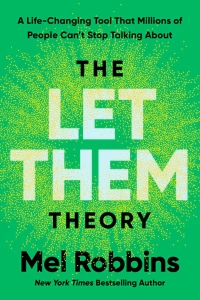
Let Them
Mel Robbins, Sawyer Robbins
Mel Robbins has become a household name in the self-help realm and it’s no wonder. Between her podcast (aptly named The Mel Robbins Podcast) and writing numerous top-selling books and audiobooks, we might as well say that this is a Mel Robbins world and we’re all living in it.
Let Them is the latest book from Mel Robbins and it’s primarily about letting go.
Why you should read it:
To bring more clarity into your life as to what to give your energy to and what not to.
Key messages:
- Giving power to other people is what keeps you feeling stuck and fearing judgment
- You can’t change the people in your life
- Let Them is about releasing the control other people have on you; Let Me is recognizing the power you have over your own life
Why it will help you:
Understanding that we give a lot of our own power to people who hurt us can really relieve the stress and pain that we inflict on ourselves. Then once we stop giving away that power, we can focus it on healthier and stronger things.

The ADHD Focus Friend
By Grace Koelma
When it comes to mental health, ADHD has really stepped into the limelight. While more and more self-help books are pouring in on the subject, it can be challenging to find the right one. The ADHD Focus Friend by Grace Koelma gets our pick for her colourful and creative approach to those living with ADHD. It’s a complete stand-out when it comes to ADHD and she knows her audience extremely well.
Why you should read it:
Half-book and half-ADHD-planner, this is an excellent tool for anyone with ADHD who wants to learn more about their struggle as well as making plans and sticking to them. Created with an engaging design that readers can appreciate, this book approaches ADHD with compassion and digestible science.
Key messages:
- You can still be productive with ADHD
- Learn how ADHD affects your emotional and sensory regulation
- You can feel empowered – not hindered – by ADHD
Why it will help you:
If you have ADHD, this book will help you identify your symptoms, learn how to manage them and help you create plans and put them in action. The planner section is undated as well, giving you the freedom to make plans for the day whenever you feel like it.


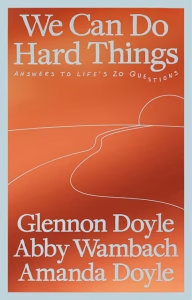
We Can Do Hard Things: Answers to Life’s 20 Questions
By Glennon Doyle, Abby Wombach and Amanda Doyle
This book is based on the popular podcast We Can Do Hard Things, where Glennon, Abby and Amanda tackle the stuff of life, from the very big to the minute. This book is chock full of insightful pearls from the hosts and guests like Sara Bareilles, Jane Fonda and Cheryl Strayed. Whether you have heard the podcast or not, this is a great book to pick up – it compiles some of the very best moments of the show.
Why you should read it:
If you find yourself asking yourself questions like Why am I like this? What do I really want? Am I a good parent?
Key messages:
- Growth requires discomfort
- Honesty and vulnerability are necessary to create strong relationships
- Find and foster your support systems for when you need to do the hard thing
Why it will help you:
Let’s be honest; life can feel extremely hard. This is a book that not only recognizes the challenges of living but offers real, grounded wisdom from noted people that have been through it as well.

Self-Compassion: The Proven Power of Being Kind to Yourself
By Kristin Neff, PhD
Do you find that you talk to yourself too harshly? That you say things to yourself you wouldn’t dare say to someone you love? Well, you’re in good company. Negative self-talk is extremely common. The concerning thing is that a lot of it passes by us completely unnoticed, like little negative ninjas delivering little cuts into our psyche. Lucky for us, Kristin Neff’s book on self-compassion is just the thing to fight back.
Why you should read it:
If you’re a person that engages in negative self-talk on a regular basis.
Key messages:
- Treat yourself as you would treat someone you love
- Self-criticism as a motivator is a myth
- You can gain self-compassion through mindful meditation
Why it will help you:
Learning core strategies such as reframing, identifying unhelpful negative thoughts, and mindful meditation can help create a happy, healthy mindset, which results in happy, healthy you!

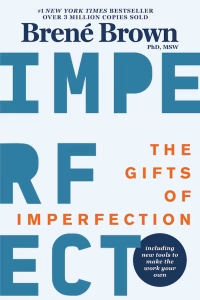
The Gifts of Imperfection: Let Go of Who You Think You’re Supposed to Be and Embrace Who You Are
By Brene Brown, PhD, MSW
Brene Brown has written a series of books such as Daring Greatly, Rising Strong and The Atlas of the Heart. We’re recommending the very first book she wrote because it’s just as vital today as it was 15 years ago when it was first published. With Brown’s ground-breaking research into shame and vulnerability, you just might find yourself returning to this book every so often for a refresher.
Why you should read it:
If you feel embarrassed or ashamed of yourself or if you feel closed off from the rest of the world.
Key messages:
- Guilt is feeling bad about something you did; shame is feeling bad about who you are
- We do not earn our worthiness, we are born with it
- If you strive for perfectionism, you block out joy and authenticity
- Vulnerability is about being weak, it’s about being courageous and true to yourself
Why it will help you:
The ability to be vulnerable with yourself and the people around you can open up a whole new world of authentic, whole-hearted living. It also fosters creativity, growth, and resiliency. And who doesn’t want that?
Mind Over Mood: Change How You Feel by Changing the Way You Think
By Dennis Greenberger, PhD and Christine A. Padesky, PhD
This book is one of the most renowned in the self-help book game. You’ve probably seen it over and over again at the bookstores or even on your therapist’s bookshelf. (Seriously, every therapist I’ve been to has this book.)
Why you should read it:
If you’re struggling with anxiety, depression, or low mood.
Key messages:
- Your core beliefs shape how you view the world
- Changing your behaviour can change how you feel
- Learning tools like thought records and behaviour experiments can help us change
Why it will help you:
It may feel like your feelings are beyond your control and sometimes that’s absolutely the case. However, you can control how you think and act. Learning and incorporating tools from the book can not only help your mood, it can empower you as well.


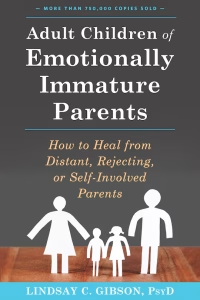
Adult Children of Emotionally Immature Parents: How to Heal from Distant, Rejecting or Self-Involved Parents
By Lindsay C. Gibson, PsyD
It’s no secret that a part of who we are comes from our childhood and parents. When we were children, we thought of our parents as the people who knew everything, who protected us and kept us alive. When we’re older, we find out that our parents are people too; replete with flaws and sometimes, absolute hot messes. Emotionally immature parents are on a whole other level and it can make life really complicated. Simply put, this self-help book is a game-changer when it comes to identifying emotionally immature parents and how to work with them.
Why you should read it:
If you feel rejected, neglected, or emotionally exploited by one or both of your parents.
Key messages:
- Growing up with emotionally immature parents can cause people to be people-pleasers, emotionally lonely, or other problems
- You are not to blame for how your parent(s) behave nor can you change them
- Learn how to emotionally re-parent yourself by building boundaries and choosing healthier relationships
Why it will help you:
In a lot of cases, we are completely bonded to our parents for better or worse. Recognizing emotional immaturity in your parent(s) can help free yourself of how they affect you and your emotions and help you break the learned behaviour pattern in relationships with your own children.